Heat exchanger effectiveness: what it measures and how to calculate it
The effectiveness of a heat exchanger is often confused with its duty. It measures something else: how close one medium gets to the temperature that is achievable at all under the given conditions. Because the result depends strongly on how the unit is operated, it is also called the operating characteristic.
What does effectiveness mean for a heat exchanger?
The physical limit lies in the two inlet temperatures: the cold medium can never become warmer than the inlet of the hot one, and the hot medium never colder than the inlet of the cold one. The difference between those two inlet temperatures is the maximum possible temperature change - and the effectiveness states which share of it is actually reached.
An effectiveness of 100 percent therefore does not mean “without losses”, but: the unit gets everything out of this pair of temperatures that there is to get.
How is effectiveness calculated?
First you need the heat capacity rate of each side without a phase change, from the mass flow and the specific heat capacity:
W = m · cp
What governs is the side with the smaller heat capacity rate - only
its temperature can fully reach the opposite side. Depending on which one
that is, and with the inlet temperatures t11 (hot) and t21 (cold) and
the outlets t12 and t22:
- hot side governing:
η = (t11 − t12) / (t11 − t21) - cold side governing:
η = (t22 − t21) / (t11 − t21)
While steam condenses, its temperature stays close to the saturation temperature; the steam side then counts as an infinitely large heat capacity rate, and the cold, liquid side governs. This holds as long as the condensate is hardly subcooled: if it cools down considerably further inside the unit, the simplification only covers the condensing section, and the condensate cooling has a finite heat capacity rate. The heat released by the steam side follows from the enthalpy difference between steam and condensate, see heating with saturated steam.
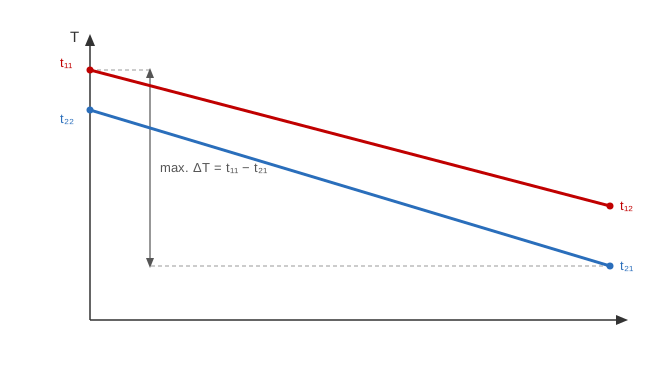
Why does the heat capacity rate decide?
Three operating cases make the difference vivid - water against water in each, with only the mass flows differing.
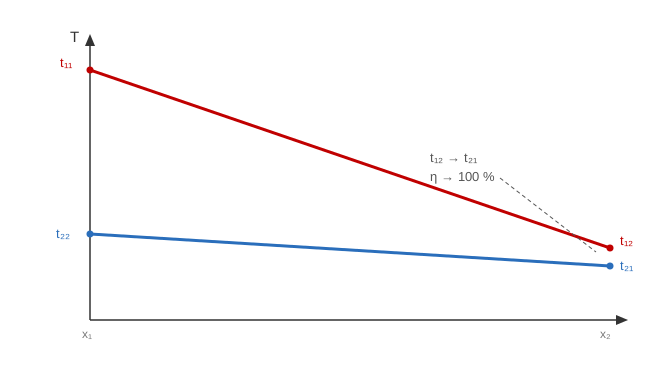
Little hot water, much cold water. The small hot stream cools strongly but barely heats the large cold volume. The calculation therefore runs over the hot side: how close does its outlet come to the cold inlet? With enough area this value tends towards 100 percent.
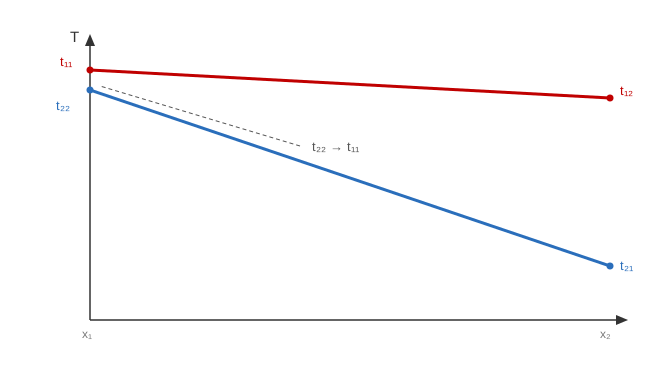
Much hot water, little cold water. Now it is the other way round: the large hot volume barely loses temperature, the small cold one heats strongly. The cold side governs; the outlet temperature of the hot side plays no part in the effectiveness.
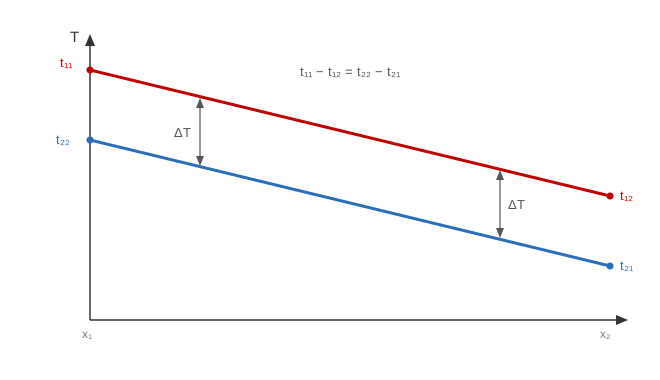
Equal heat capacity rates. If both sides are equal, both routes give the same result - the temperature change is the same on both sides, and in counterflow the curves run parallel.
What does this mean for sizing?
High effectiveness is not an end in itself. The last percentage points cost disproportionately much area, because the driving temperature difference keeps shrinking towards the end - exactly the effect the log mean temperature difference describes. It therefore makes sense to define the operating point and choose the margin deliberately, rather than maximising a single figure. Our configurator shows the temperatures reached alongside; the quote states the margin.
Frequently asked questions
What does the effectiveness of a heat exchanger actually measure?
Not the transferred duty, but how closely one medium approaches the theoretically possible limit temperature - that is, the inlet temperature of the other medium. 100 percent means the limit is reached; with this pair of temperatures nothing more is physically possible.
Which medium governs the calculation?
For media without a phase change, the one with the smaller heat capacity rate, meaning the smaller product of mass flow and specific heat capacity. Only its temperature can fully approach the inlet temperature of the opposite side. While steam condenses, its temperature stays close to the saturation temperature; the steam side then counts as an infinitely large heat capacity rate, and the liquid side governs. This holds as long as the condensate is hardly subcooled - its further cooling has a finite heat capacity rate.
Can a heat exchanger reach 100 percent effectiveness?
Arithmetically yes, if the area is large enough and the heat capacity rates are far apart. In practice the limit is approached asymptotically: the last few percentage points cost disproportionately much area.
Request a sizing
Describe your application in the configurator - we will come back to you with an individual quote.